sana › Herbs & Plants › Cinnamon
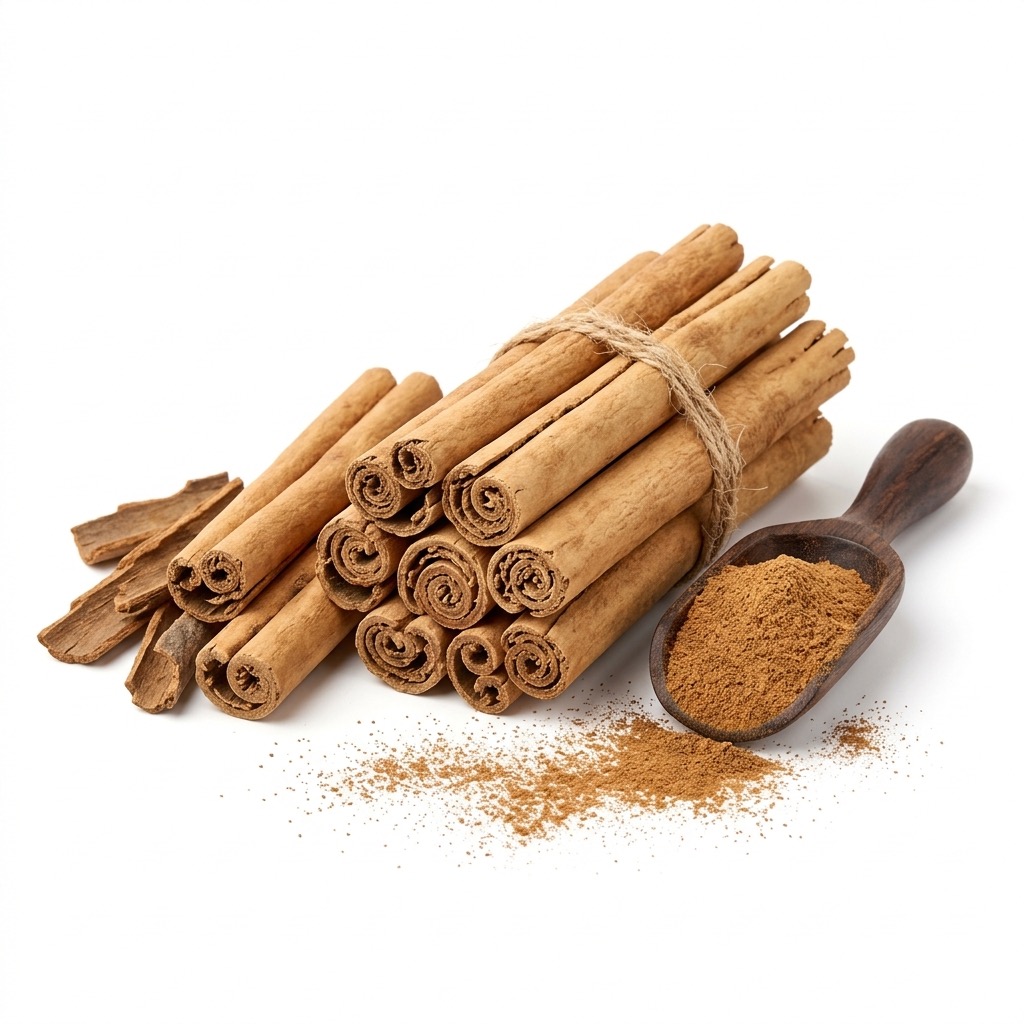
Cinnamon · Cinnamomum verum
Photo: (c) Sayee Girdhari, some rights reserved (CC BY) · CC BY · via iNaturalist
Herbs & Plants
Cinnamon
Cinnamomum verum
Cinnamon is not one plant but several. What sits in most American kitchens is cassia. The true cinnamon is Ceylon, and it costs more. They taste alike, but cassia carries coumarin, a compound that stresses the liver in large daily amounts, and Ceylon has almost none.
Benefits
Cinnamon brings a high fasting reading down. The longer-term measure — the one that averages months rather than hours — doesn't move, so this shows up day to day and not over the year.
Cinnamon lowers total cholesterol and the harmful kind that furs up the arteries.
Cinnamon helps with several of the things that strain the heart, including blood fats and blood pressure.
What It Is Known For
It moves a fasting reading and leaves the long-term measure untouched, which is not what treating diabetes means.
Nothing tests this in people, and it's the claim that sells the most cinnamon capsules.
A warm cinnamon drink is comforting. Nothing shows it shortens anything.
Cinnamon oil kills yeast in a dish and in the mouth. Swallowed, nothing shows it reaching anywhere else.
The line is everywhere and no price record supports it — the same story we found and rejected for cloves.
Key Active Compounds
the compound behind most of what cinnamon does
heavy in cassia, almost absent in Ceylon
Traditionally Used
A stick of Ceylon cinnamon simmered in a cup of water for ten minutes, drunk hot at the first sign of a cold.
How to Take It / Use It
Stir up to 1/2 teaspoon of Ceylon cinnamon into food or yogurt each day, and eat it. Or simmer a stick in water for 10 minutes and drink it.
Stir about 3/4 teaspoon of Ceylon cinnamon into food each day, and eat it.
Why It Works
Cinnamon seems to make the body's insulin more effective, so sugar clears a little faster.
Cautions
Cassia, the cinnamon in most supermarket jars, carries coumarin, which harms the liver in large amounts.
An adult passes it at about two grams of cassia and a child at about half a gram, so take Ceylon and never give cinnamon to a child as a daily remedy.
Where It Comes From
Ceylon cinnamon comes from Sri Lanka and the southwest coast of India, and Sri Lanka still grows most of it. Cassia comes from southern China and is now grown across China, Vietnam and Indonesia. Both are the inner bark of a small tree, peeled off in strips and dried until it curls.
How We Choose It
We check every product so you don't have to. A cinnamon only makes our list if:
- Ceylon, or Cinnamomum verum, on the label. Anything sold simply as cinnamon is cassia.
- Cassia carries coumarin, which harms the liver in large daily amounts. Ceylon has almost none.
- Capsules hold ground Ceylon cinnamon and nothing else. No cassia, no blend, and nothing added to help it absorb.
If no product meets these standards, we don't list one. No exceptions for affiliates.
See our picks
Sources17
- Cleveland Clinic. Potential health benefits of cinnamon. Health essentials
- Johns Hopkins Medicine. Spices with healthy benefits. Wellness
- Healthline. Health benefits of cinnamon. Review
- Mayo Clinic. Does cinnamon lower cholesterol? Expert answer
- Gou H, et al. "The effects of cinnamon on patients with metabolic diseases: an umbrella review." Frontiers in Nutrition, 2025. Full text
- Jafari A, et al. "Cinnamon supplementation and cardiovascular risk factors in adults." Journal of Health, Population and Nutrition, 2025. Full text
- Zhang K, et al. "Cinnamon, blood pressure, oxidative stress and inflammation: an umbrella review." Nutrition, Metabolism and Cardiovascular Diseases, 2024. PubMed
- Moridpour AH, et al. "Cinnamon and glycemic control in type 2 diabetes." Phytotherapy Research, 2024. PubMed
- Zarezadeh M, et al. "Cinnamon and glycemic control in type 2 diabetes and PCOS: umbrella meta-analysis." Diabetology & Metabolic Syndrome, 2023. Full text
- Ojo O, et al. "Cinnamon improves glycated haemoglobin and body mass index." Endocrines, 2025. Full text
- Fateh HL, Amin SM. "Cinnamon supplementation and lipid profile." Clinical Nutrition Research, 2024. Full text
- Wu T, et al. "Cinnamon and lipid profiles in metabolic syndrome." Complementary Therapies in Clinical Practice, 2022. PubMed
- Hadi A, et al. "Cinnamon and blood pressure in adults." Clinical Nutrition ESPEN, 2020. ScienceDirect
- Zelicha H, et al. "Cinnamon and continuously monitored glucose in prediabetes." American Journal of Clinical Nutrition, 2024. Full text
- Muthukuda D, et al. "Ceylon cinnamon extract on lipids and glucose: a randomized trial." PLOS ONE, 2025. Full text
- Memorial Sloan Kettering Cancer Center. "Cinnamon — About Herbs." Monograph
- Mohsin SN, et al. "Prospective nutraceutical effects of cinnamon derivatives against insulin resistance in type II diabetes mellitus — evidence from the literature." Dose-Response, 2023. Review