sana › Herbs & Plants › Tea Tree Oil
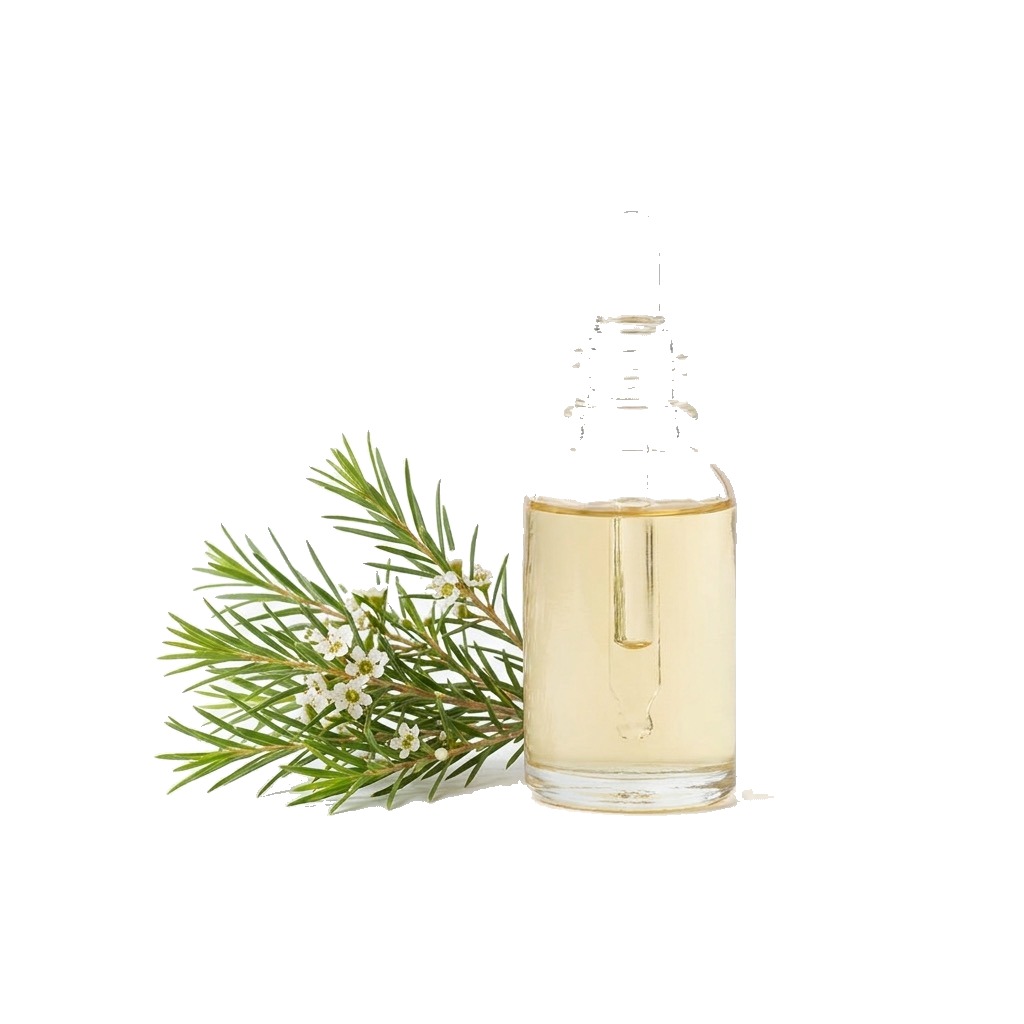
Tea Tree Oil · Melaleuca alternifolia
Photo: (c) Bruce Cathie, some rights reserved (CC BY) · CC BY · via iNaturalist
Herbs & Plants
Tea Tree Oil
Melaleuca alternifolia
Tea tree grows wild in a swampy coastal region of Australia, and on commercial farms it never needs to be replanted. During harvest the entire tree is cut close to the ground, and it grows straight back from the stump for future harvests. The leaves yield a primary active compound called terpinen-4-ol, but the amount of it varies drastically from bottle to bottle.
Benefits
Tea tree oil clears the spots of ordinary acne. It kills the bacteria that inflame a pore and calms the redness around it.
Tea tree oil clears athlete's foot. It breaks open the wall of the fungus and stops it spreading further into the skin.
Tea tree oil brings down dandruff flaking and the itch that comes with it. Dandruff is caused by a yeast that lives on everyone's scalp, and tea tree holds it back.
Tea tree oil brings down bleeding gums and the plaque that causes them. It kills the bacteria in the sticky film along the gum line, and it leaves no brown stain on the teeth.
A tea tree and lavender treatment clears head lice over a few weeks.
What It Is Known For
A teaspoon has caused vomiting, slurred speech and drowsiness, and this is one to keep out of a child's reach rather than one to take.
At the strength that works on a foot it left some people with a moderate to severe rash, and at a gentle strength it did no better than doing nothing.
Tea tree oil is sold for this everywhere, and nothing tests it properly.
The mites drop and the crusting and itching stay, so it is not the eyelid answer it is sold as.
Key Active Compounds
the main germ-fighting compound, and the one that damages cell walls
helps break the walls down faster
helps the oil soak into the skin
How to Take It / Use It
1 drop of tea tree oil in 5 drops of carrier oil or moisturizer, dabbed on the spot with a cotton swab.
Mix 1 part tea tree oil with 3 parts carrier oil and paint it between the toes twice a day.
Mix 5 drops into a handful of your usual shampoo and wash with it.
Stir 3 to 6 drops into a small glass of water, swish it around the mouth and spit it out.
Apply a ready-made tea tree lice product to the scalp.
Why It Works
Terpinen-4-ol mixes into the outer fat layer of a bacterium and opens it up.
The cell can no longer breathe or make energy.
The inside leaks out and the bacterium dies.
A fungus wall is built from a different fat, and terpinen-4-ol loosens that one too.
It quiets the immune cells behind swelling and redness.
Cautions
Tea tree oil is poisonous swallowed, and a single teaspoon has caused vomiting, slurred speech and an inability to walk, so keep the bottle capped, labeled and out of reach of children.
Never put undiluted tea tree oil near the eyes — use a ready-made eyelid wipe instead.
Oil that has been open more than a year turns into a common cause of skin rash, so keep the bottle tightly closed and replace it.
The strength that clears a foot is strong enough to leave some people with a moderate to severe rash, so stop if the skin reddens.
Where It Comes From
The tree grows wild in one place only, the swampy river flats of northern New South Wales and southern Queensland. Australia supplies most of the world, with China, Kenya and South Africa now growing it too.
How We Choose It
We check every product so you don't have to. A tea tree oil only makes our list if:
- Melaleuca alternifolia on the label. Cajuput, niaouli, manuka and lemon tea tree are all sold as tea tree and are not the same plant.
- Steam-distilled from fresh leaves and twigs. That's the traditional method — it keeps the oil intact.
- Amber glass, small bottle. Air, light and warmth make the oil weaker and more likely to cause a rash.
- A lice product combining tea tree with lavender. What cleared 41 of 42 children was tea tree at 10% with lavender at 1%. It went on three times, a week apart. Tea tree on its own has not been tested that way.
If no product meets these standards, we don't list one. No exceptions for affiliates.
See our picks
Sources15
- Plants of the World Online, Royal Botanic Gardens Kew. Melaleuca alternifolia (Maiden & Betche) Cheel. Accepted name and native range. Kew
- Carson CF, Hammer KA, Riley TV. Melaleuca alternifolia (tea tree) oil: a review of antimicrobial and other medicinal properties. Clinical Microbiology Reviews 19(1):50, 2006. The standard reference on composition and mechanism. Review
- Cox SD, et al. The mode of antimicrobial action of the essential oil of Melaleuca alternifolia. Journal of Applied Microbiology 88(1):170, 2000. Potassium leakage and the collapse of respiration. Paper
- ISO 4730, Essential oil of Melaleuca, terpinen-4-ol type. Minimum thirty-five percent terpinen-4-ol, maximum ten percent 1,8-cineole. Standard
- Bassett IB, Pansey DL, Barnetson RS. A comparative study of tea-tree oil versus benzoylperoxide in the treatment of acne. Medical Journal of Australia 153(8):455, 1990. Benzoyl peroxide worked better; tea tree was better tolerated. Abstract
- Satchell AC, et al. Treatment of dandruff with 5% tea tree oil shampoo. Journal of the American Academy of Dermatology 47(6):852, 2002. Abstract
- Satchell AC, et al. Treatment of interdigital tinea pedis with 25% and 50% tea tree oil solution. Australasian Journal of Dermatology 43(3):175, 2002. Abstract
- Buck DS, Nidorf DM, Addino JG. Comparison of two topical preparations for the treatment of onychomycosis. Journal of Family Practice 38(6):601, 1994. The eighteen percent figure for nails. Abstract
- Barker SC, Altman PM. A randomised, assessor blind, parallel group comparative efficacy trial of three products for the treatment of head lice. BMC Dermatology 10:6, 2010. Full text
- Scientific Committee on Consumer Products, opinion on tea tree oil. Oxidation, p-cymene as a spoilage marker, and oxidized oil as a stronger sensitizer. Opinion
- Braunstein EW, Braunstein GD. Do lavender and tea tree oils cause gynaecomastia? touchREVIEWS in Endocrinology, 2023. A review of all twelve published cases, finding the link unproven. Review
- National Center for Complementary and Integrative Health. Tea tree oil. Summary
- Poison Control, National Capital Poison Center. Tea tree oil poisoning. Cases, symptoms and the corneal damage warning. Article
- Australian Dictionary of Biography. Penfold, Arthur Ralph (1890 to 1980), economic chemist and museum director. Biography
- AgriFutures Australia. Tea tree oil industry profile, including yields, breeding and the adulteration work behind the standard. Profile