sana › Herbs & Plants › Chamomile
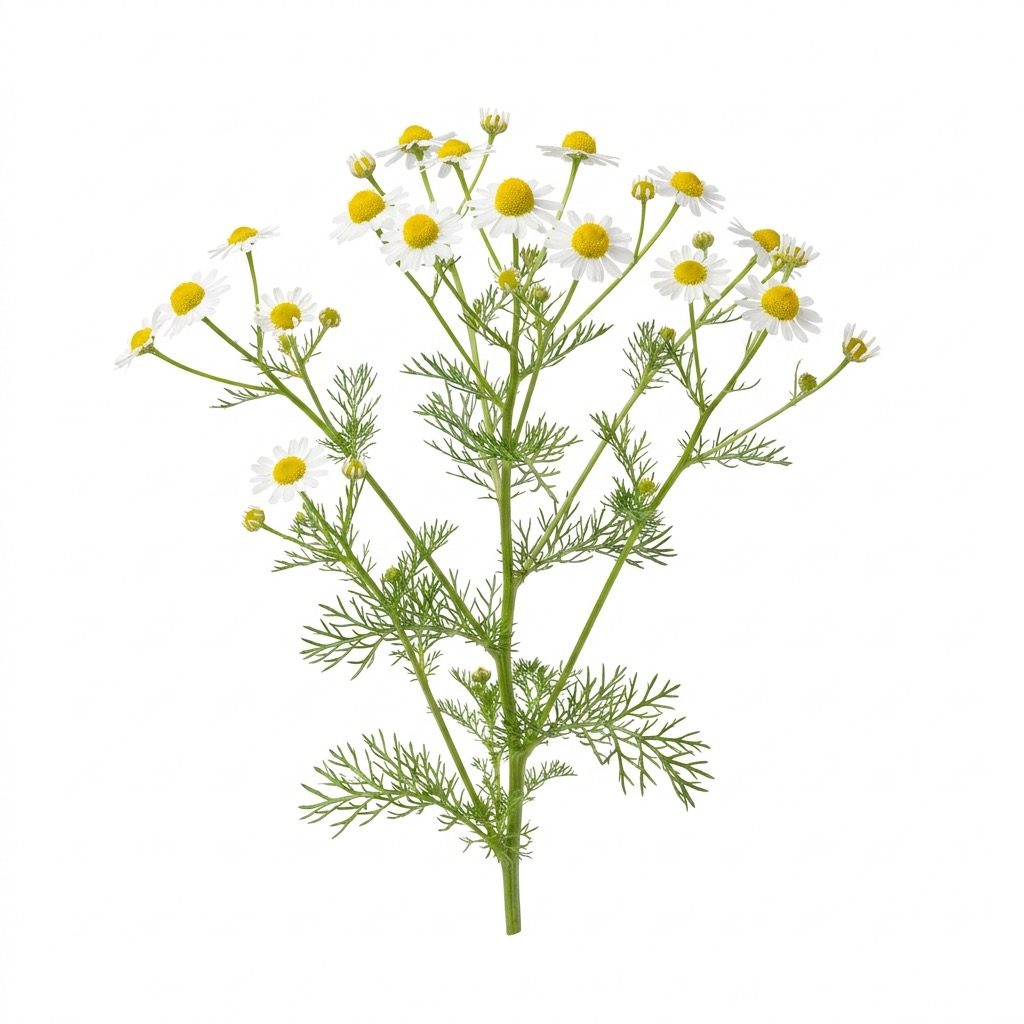
Chamomile · Matricaria chamomilla
Photo: (c) Alexis Tinker-Tsavalas, some rights reserved (CC BY) · CC BY · via iNaturalist
Herbs & Plants
Chamomile
Matricaria chamomilla
Chamomile oil is deep ink blue, though the flower has no blue in it anywhere. The color is made in the still, when heat turns one compound into another. If the oil you bought is not blue, it is not German chamomile — and German is the one almost everything known about chamomile is about.
Benefits
Chamomile takes the edge off nerves that have been on edge for weeks. Capsules of chamomile extract are what was tested.
Chamomile may help you drop off, though it has worked for some people and not others.
Cooled chamomile tea, swilled and spat out, calms the tissue around an ulcer.
Chamomile cream calms the redness and soreness of an irritated patch.
What It Is Known For
It has helped in some trials and not in others, and one set of national guidelines advises against it for long-running insomnia.
The one piece of work behind this used a tea of several herbs, and a baby had to drink more of it than a baby will drink.
Nothing tests it, and it is the tradition of a grandmother rather than a finding.
It is a daisy, and people who react to ragweed and marigolds can react to this too.
Key Active Compounds
The flavone chamomile is measured by.
One of the two main compounds in the oil.
forms when the flower is distilled, and turns the oil blue
How to Take It / Use It
Put a tablespoon of dried flower heads in a cup of just-boiled water and cover it while it steeps, five to ten minutes. Cover it or the oils leave with the steam.
Steep one to five grams of flowers in a cup of water and let it go cold. Swill it around the mouth and spit it out, several times a day.
Steep a tablespoon of flowers in a quart of hot water, soak a cloth in it and lay it on the skin. For a wider area, add about five grams to a quart of bath water.
Why It Works
Your brain has a braking system, and calming medicines work by holding that brake down harder. Apigenin fits the same lock but turns it far more gently. That is why chamomile takes the edge off without knocking you out.
Bisabolol and chamazulene both quiet the chemical signals that make skin red, hot and swollen. This is why chamomile does more for the outside of you than the inside.
Cautions
People who are allergic to plants in the daisy family, such as ragweed, marigolds, daisies and chrysanthemums, may have an allergic reaction.
Where It Comes From
German chamomile grows wild from Portugal to Korea. Roman chamomile is an Atlantic plant, native to Britain, Ireland, France, Spain and Morocco. Most dried chamomile now comes from Egypt, Hungary, Argentina and Croatia.
How We Choose It
We check every product so you don't have to. A chamomile only makes our list if:
- German chamomile, Matricaria chamomilla. Roman chamomile is a different plant and almost nothing known about chamomile is about it.
- Whole dried flower heads, not powder. Crushed chamomile loses its oils — and the oils are what make the tea work.
- Capsules hold German chamomile extract and say how much. The calming work was done on capsules rather than tea, and a capsule that does not say what is in it was never measured.
If no product meets these standards, we don't list one. No exceptions for affiliates.
See our picks
Sources12
- European Medicines Agency. EU herbal monograph on Matricaria recutita, flos. The five approved uses, and the dosing for adults and children. Monograph
- European Medicines Agency. Assessment report on Chamaemelum nobile, flos. Roman chamomile, and why its evidence is thinner. Assessment
- NCCIH. Chamomile. The National Center for Complementary and Integrative Health, on what the evidence does and does not support. Summary
- Memorial Sloan Kettering Cancer Center. Chamomile (German). Drug interactions and reported adverse effects. Monograph
- Amsterdam JD, et al. A randomized, double-blind, placebo-controlled trial of oral Matricaria recutita for generalized anxiety disorder. Journal of Clinical Psychopharmacology, 2009. PubMed
- Mao JJ, et al. Long-term chamomile therapy for generalized anxiety disorder. Phytomedicine, 2016. The relapse-prevention trial that missed its primary endpoint. PubMed
- Hieu TH, et al. Therapeutic efficacy and safety of chamomile for state anxiety, generalized anxiety disorder, insomnia and sleep quality. Phytotherapy Research, 2019. Meta-analysis
- Zick SM, et al. Preliminary examination of the efficacy and safety of a standardized chamomile extract for chronic primary insomnia. BMC Complementary and Alternative Medicine, 2011. Null on every primary outcome. Full text
- Biagioli E, et al. Pain-relieving agents for infantile colic. Cochrane Database of Systematic Reviews, 2016. Cochrane
- Patzelt-Wenczler R, Ponce-Poeschl E. Proof of efficacy of Kamillosan cream in atopic eczema. European Journal of Medical Research, 2000. PubMed
- Segal R, Pilote L. Warfarin interaction with Matricaria chamomilla. CMAJ, 2006. The bleeding case report. Full text
- Kew Royal Botanic Gardens. Plants of the World Online: Matricaria chamomilla and Chamaemelum nobile. Native ranges. POWO