sana › Herbs & Plants › Turmeric
Herbs & Plants
Turmeric
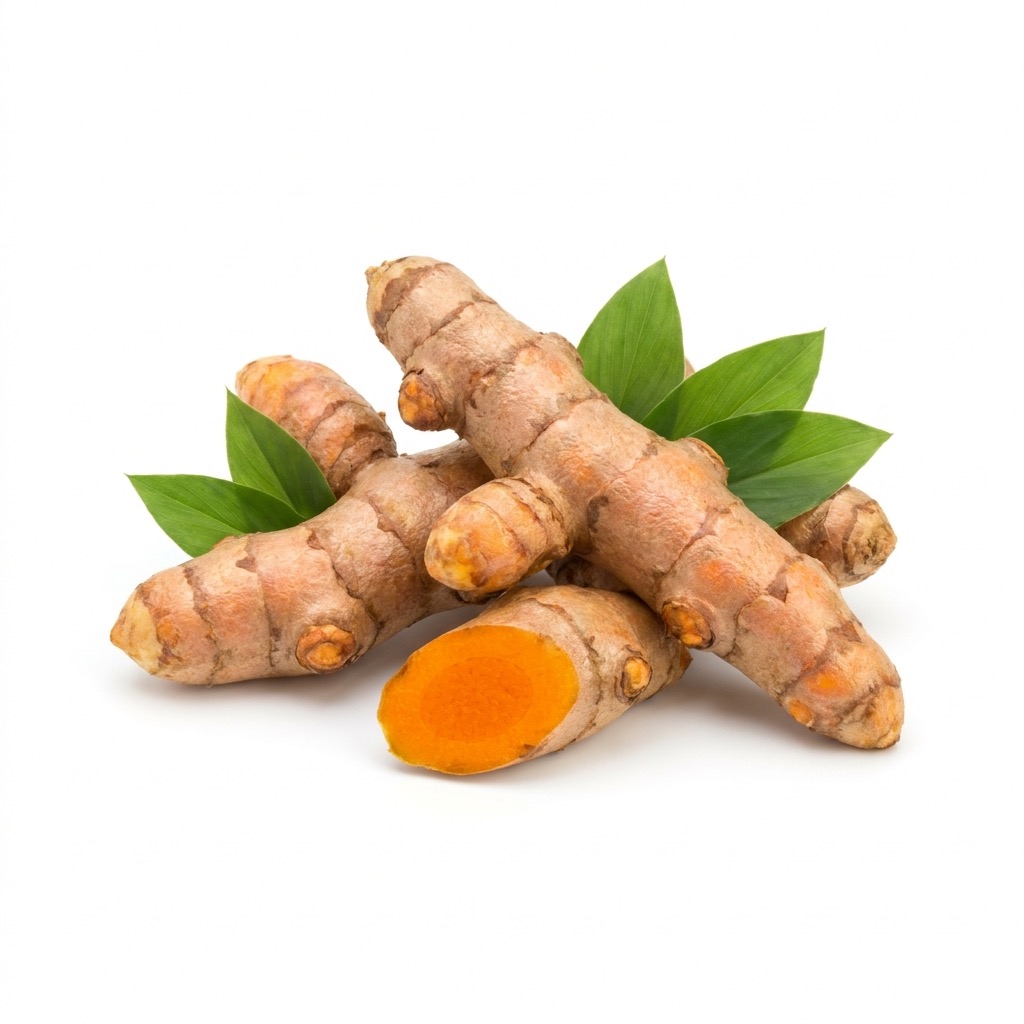
Curcuma longa
Every turmeric plant alive is a cutting of a cutting, going back thousands of years to the first piece of root someone chose to replant. Marco Polo met it in China in 1280 and called it Indian saffron, because it turned food the same gold and cost almost nothing.
Benefits
A turmeric gel or cream brings the redness and scaling down.
Turmeric paste dabbed on the spot eases the pain.
It builds up steadily rather than working the moment you take it.
Eases the fullness and burning that follow a meal.
What It Is Known For
This comes from cells in a dish given concentrations no person could ever reach, and it has never held up in people.
Laboratory work only. The human trials that have been run came back empty.
Animal work says one thing and the real world says another — turmeric is now the most common herbal cause of liver injury in America.
True in a dish. Nothing shows it after swallowing.
Curcumin eases joint pain; nothing repairs a worn joint.
Key Active Compounds
the yellow pigment, and the compound behind most of what turmeric does
the oil that helps the yellow absorb
Traditionally Used
A teaspoon simmered in milk with pepper, drunk at night.
Haldi chaas: 1 teaspoon of turmeric whisked into a cup of yogurt with two cups of water, roasted cumin, a little black pepper and salt, drunk after eating.
How to Take It / Use It
Mix turmeric powder with a little water into a thick paste, spread it on for 10 to 20 minutes, then wash it off. It stains for a day.
Mix turmeric powder with a few drops of water into a paste and dab it on the spot. Leave it a minute, then rinse.
Cautions
The cases cluster in concentrated extract, especially the high-absorption kind sold with black pepper or piperine added — a few have followed plain powder or tea.
Stop the extract and get checked, because the injury usually shows after one to four months and usually clears within one to three months of stopping.
In the American cases gathered so far, five people were hospitalized and one died.
Turmeric slows clotting, so keep to food amounts before surgery or if you take blood-thinning medicine.
Where It Comes From
Turmeric comes from southwest India and is grown from pieces of root rather than from seed. India grows about eighty percent of the world's supply. The roots are boiled, dried in the sun for a week or more, then polished in drums until the rough skin comes off and the color comes up.
How We Choose It
We check every product so you don't have to. A turmeric powder only makes our list if:
- Two products, and the page says which is which. The skin and mouth benefits are the powder, used as a paste. The joint and digestion benefits are the extract, sold openly as an extract — a teaspoon of powder does not come close to the amounts behind them.
- The jar says how much curcumin is in it. Curcumin is the part that actually works. If the label doesn't say, the company never tested it.
- It has at least 6% curcumin. Regular supermarket turmeric only has 2 to 3%.
- The brand tests for lead and publishes the results. Some cheap turmeric is colored with lead paint pigment to look brighter. Yes, really.
- The label lists one ingredient: turmeric. Nothing else. Cheap powders are stretched with flour or starch.
- The extract's label states its curcuminoid content. A number means somebody measured it. No number means nobody looked.
- Standardized, and the label says so. That means every batch is made to hit the same strength, so the second bottle matches the first.
- Third-party test results published. A company that pays an outside lab puts the certificate where you can read it. One that doesn't, doesn't.
- One ingredient, plus a carrier if it names one. Turmeric extract and at most a named oil to carry it. Nothing else in the list.
- Nothing added to push absorption. Piperine, phytosome, “high absorption” — anything folded in to force more through makes it stronger than the plant.
- Capsules, not tablets. Pressing needs binders and fillers, so a tablet is never only the extract.
If no product meets these standards, we don't list one. No exceptions for affiliates.
See our picks
Sources21
- Harvard Health. Turmeric benefits: a look at the evidence. Review
- Healthline. Health benefits of turmeric. Review
- Riverside Health. What this golden spice can do for your health. Article
- Johns Hopkins Medicine. Turmeric benefits. Expert Q&A
- Cleveland Clinic. Turmeric health benefits. Health essentials
- GoodRx. Turmeric benefits. Review
- Plants of the World Online, Royal Botanic Gardens Kew. Curcuma longa L., recorded as a cultigen from southwest India with no wild population. Kew
- Nelson KM, Dahlin JL, Bisson J, Graham J, Pauli GF, Walters MA. The essential medicinal chemistry of curcumin. Journal of Medicinal Chemistry 60(5):1620, 2017. Why curcumin gives false positives across laboratory tests. Paper
- Shoba G, et al. Influence of piperine on the pharmacokinetics of curcumin in animals and human volunteers. Planta Medica 64(4):353, 1998. The original twentyfold figure. Abstract
- Jager R, et al. Comparative absorption of curcumin formulations. Nutrition Journal 13:11, 2014. Full text
- Kuptniratsaikul V, et al. Efficacy and safety of Curcuma domestica extracts compared with ibuprofen in patients with knee osteoarthritis. Clinical Interventions in Aging 9:451, 2014. The source of the turmeric versus ibuprofen claim, and it had no placebo arm. Full text
- Lang A, et al. Curcumin in combination with mesalamine induces remission in patients with mild to moderate ulcerative colitis. Clinical Gastroenterology and Hepatology 13(8):1444, 2015. Abstract
- LiverTox. Turmeric. National Institute of Diabetes and Digestive and Kidney Diseases. Likelihood score A, the top tier of herbal causes of liver injury. Entry
- Halegoua-DeMarzio D, et al. Liver injury associated with turmeric, a growing problem. American Journal of Medicine 136(2):200, 2023. Ten cases, one death, and piperine in most of the products analyzed. Paper
- National Center for Complementary and Integrative Health. Turmeric. Includes the warning on highly bioavailable formulations. Summary
- Forsyth JE, et al. Turmeric means yellow, but the source of adulteration is lead chromate. Environmental Research 179:108722, 2019. The Bangladeshi lead story traced by isotope. Paper
- Consumer Reports. Your herbs and spices might contain arsenic, cadmium and lead, 2021. Testing of turmeric on American shelves. Report
- Lee SS, et al. Prevalence of dementia in India, results from LASI-DAD. Alzheimer's and Dementia 19(7):2898, 2023. India's dementia rate is comparable to the United States, which ends the turmeric and Alzheimer's story. Paper
- Retraction Watch. The retraction record of the most prolific curcumin researcher, thirty retractions by 2022. Report
- Saraf-Bank S, et al. Effects of curcumin on blood lipids, an umbrella review. Nutrition Reviews, 2025. Review
- UNESCO Intangible Cultural Heritage. Jamu wellness culture, inscribed 2023. Listing